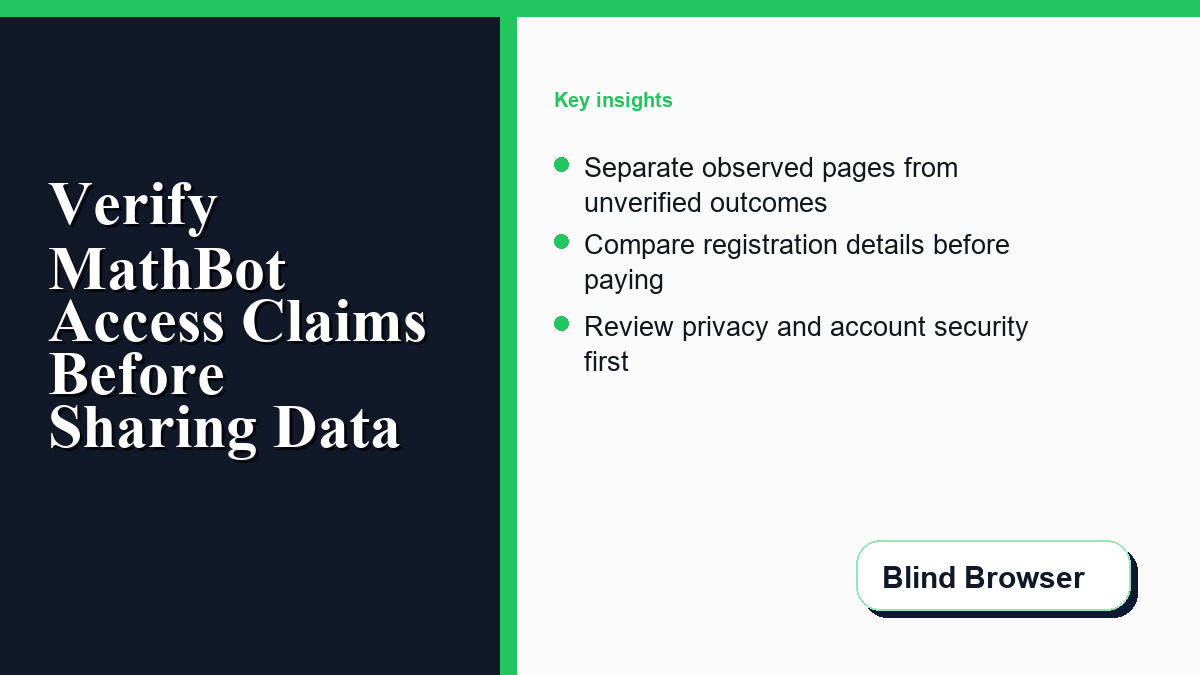
A working sign-in page can show that an online service has an access route. It cannot, by itself, confirm who operates the service, how a fee is used, whether advertised tasks are available, or what result a user will receive. A careful review starts by separating what can be observed from what is still unverified.
This guide offers a practical way to evaluate MathBot access claims before you share personal data or pay a registration charge. It is an independent verification checklist, not a recommendation to join. If you want the dated source observations behind the checklist, read this independent MathBot access and claim review.
Start with a claim-to-evidence map
Online offers often place several different statements close together: an access page, a registration process, a price, a trial activity, and a description of what may happen after joining. Readers can easily combine those statements into one broad conclusion. A better method is to evaluate each statement separately.
| Observed item | What it can establish | What remains unverified |
|---|---|---|
| A page accepts sign-in details | An access interface was available at the time checked | Operator identity, account protection, and future availability |
| A page lists a registration charge | A displayed price can be recorded and compared | The reason for the charge and the outcome after payment |
| A trial activity appears | The displayed activity can be documented | The availability or terms of later compensated work |
| A support contact is listed | A contact route is presented | Response quality, dispute handling, and resolution time |
The important discipline is simple: record the narrow fact that the evidence supports. Do not upgrade a page observation into a conclusion about the entire service.
Compare registration details before paying
When different pages show different registration amounts, pause. Capture the page address, displayed amount, currency, date, and any conditions shown next to the charge. A price conflict may reflect a page update, a regional variation, or an inconsistency. The conflict itself does not explain which amount will apply to you.
Before making a payment, look for a clear description of what the charge covers, whether it is refundable, which organization receives it, and how a dispute can be raised. Avoid relying on a screenshot forwarded by another person when you can inspect the current page yourself. The Federal Trade Commission’s guidance on job scams also recommends caution when an opportunity asks a person to pay for access to work.
Review privacy and account security first
A privacy notice may describe categories of information collected, such as contact details, device information, or activity data. Read that description before creating an account. Check whether it explains why information is collected, how long it is retained, whether it is shared, and how a user can request access or deletion.
Use a unique password. Do not reuse an email, banking, social, or business password. Do not provide an email password, one-time security code, recovery phrase, or remote-control access to another party. CISA’s phishing recognition guidance explains how urgency, unusual requests, and deceptive links can be warning signs. NIST also maintains general multi-factor authentication guidance for protecting accounts.
Account safeguards reduce the impact of a password leak, but they do not validate a business claim. Security hygiene and claim verification are separate checks, and both matter.
Treat trial activities as demonstrations
A trial task can demonstrate an interface or workflow. It should not be treated as evidence that later activities will be available, compensated, or governed by the same terms. Record exactly what the trial showed. Then look for separate written terms covering eligibility, availability, review criteria, compensation, timing, fees, and dispute handling.
If those terms are absent or unclear, classify the outcome as unverified. That is a more accurate conclusion than trying to infer a promise from an interface. A neutral “not enough evidence yet” decision protects you from filling gaps with assumptions.
Use a repeatable verification workflow
- Open the page directly. Type or inspect the address instead of trusting a forwarded button or shortened link.
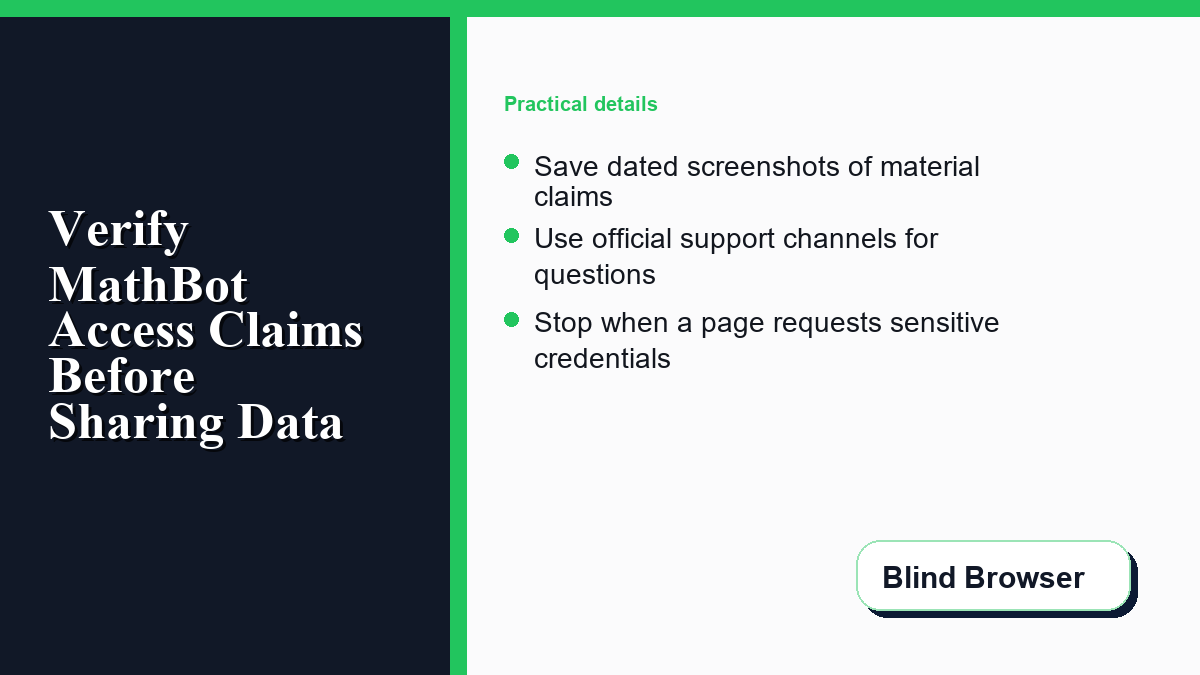
- Save dated evidence. Capture the page address, title, price, terms, and date for any detail that could affect your decision.
- Separate observations from conclusions. Write down what the page proves and what it does not prove.
- Check operator information. Look for a legal entity, usable contact route, governing terms, privacy notice, and dispute process.
- Protect credentials. Use a unique password and do not share security codes, recovery details, or remote access.
- Ask specific questions. Request written clarification of fees, refunds, data handling, and the exact service provided.
- Stop when the evidence conflicts. Resolve material differences before sharing more data or money.
Build a small evidence file before deciding
A simple evidence file makes conflicts easier to spot. Create one row for each material statement and include the exact page address, the wording you observed, the date and time, and the question that remains. Keep screenshots in their original form instead of cropping away the address bar or nearby conditions. A complete capture is more useful when a page changes later.
Give each row one of three labels: observed, supported, or unresolved. “Observed” means the page displayed the statement. “Supported” means an appropriate primary source or clear written term backs it. “Unresolved” means the available material is missing, inconsistent, or too broad for the evidence. These labels prevent a collection of narrow observations from turning into a stronger conclusion than the sources justify.
Pay special attention to details that influence a financial or privacy decision: the recipient of a charge, refund conditions, recurring charges, data-retention periods, account-deletion steps, dispute contacts, and any deadline. If support provides clarification, save the complete exchange and note who responded. A short answer that avoids the question should remain unresolved.
This process does not require specialist software. A dated document and a folder of screenshots are enough. The value comes from using the same standard for every claim and waiting when the evidence does not meet it.
Know what a careful review can and cannot conclude
A sound review can confirm that a particular page existed, displayed certain text, or requested certain information on a specific date. It can compare those observations with public terms and general consumer-safety guidance. It cannot establish how a service will operate tomorrow or what another user will experience.
That limitation is useful, not frustrating. It keeps the conclusion matched to the evidence. If the available material is incomplete, the appropriate result is to wait, ask for clarification, or choose a lower-risk alternative.
Continue with Blind Browser guides on checking an AI chatbot before sharing private information and verifying online offers without weakening account security.
Frequently asked questions
Does a working MathBot sign-in page prove the full service is verified?
No. It shows that an access page was available when checked. Operator identity, data handling, service terms, and user outcomes require separate evidence.
What should I do if two pages show different registration prices?
Save both pages with their addresses and dates, then request written clarification before paying. Do not assume which amount is current.
Does a trial task prove later compensated tasks are available?
No. Treat a trial as a demonstration unless separate, current terms explain availability, eligibility, compensation, and timing.
What information should I avoid sharing?
Do not share email or banking passwords, one-time security codes, recovery phrases, or remote-control access. Review the privacy terms before submitting personal information.
What is the safest conclusion when evidence is incomplete?
Classify the claim as unverified and pause. Ask for written clarification or choose an option with clearer operator, privacy, payment, and dispute information.