Adding an AI chat widget to a website usually takes one embed code and five minutes. Understanding what that widget actually does with a visitor’s conversation takes considerably longer, and most site owners skip that part entirely.
The Gap Between What a Site Says and What It Does
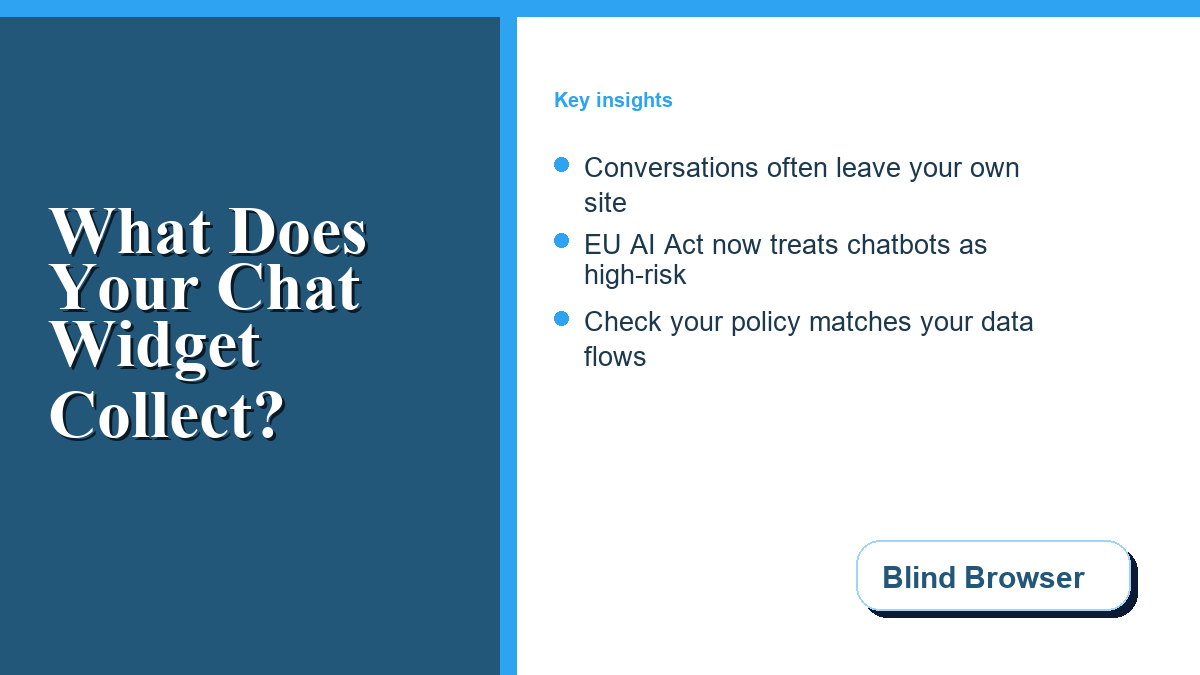
If a chat widget sends visitor conversations to a third-party model provider while the site’s privacy policy only mentions analytics cookies, the site’s actual data flows no longer match what it discloses. That gap is not a hypothetical compliance risk — it’s the literal, common state of a huge number of small business websites that added a chat widget without updating a privacy policy written before the widget existed.
Where the Data Actually Goes
Most SaaS chat widgets are fast to deploy specifically because someone else’s servers are doing the work — and that means conversation data leaves the site’s own infrastructure the moment a visitor types a message. For a site with visitors in the EU, that raises a specific, concrete issue: many chat providers store conversation data in US-based data centers, and transferring EU personal data to the US legally requires Standard Contractual Clauses, a Transfer Impact Assessment, and a Data Processing Agreement — paperwork most small sites installing a five-minute widget have never heard of, let alone completed.
What Changed in 2026 Specifically
The EU AI Act, in force since August 2026, classifies chatbots as high-risk systems requiring documented risk assessments, transparency to users, human oversight, and an audit trail. Colorado’s AI Act, effective earlier in the year, requires impact assessments for high-impact AI systems along similar lines. Compliance for an AI chat widget is no longer an optional nice-to-have — for a growing list of jurisdictions, it’s now a baseline legal requirement, not a future concern.
A Practical Inventory Before Adding (or Auditing) a Widget
- What does the widget actually send to its provider? Full conversation text, metadata, page context — get a specific answer, not a general one.
- Where is that data stored, and for how long? “The cloud” is not an answer a compliant business can operate on.
- Does the widget show a consent screen before the conversation starts? Requiring explicit acceptance of terms before collection begins is the baseline, not an advanced feature.
- Does the site’s actual privacy policy mention this data flow? If not, that’s the first thing to fix, before evaluating anything else about the widget.
A widget built with these questions answered by design — clear data handling, visible consent, documented flows — is a fundamentally different proposition than one bolted onto a site with no privacy review at all. Charigent’s embeddable AI widgets are one example of that kind of deployment, built to be embedded with the data-handling question already answerable.
The Bottom Line
An AI chat widget is not a decoration bolted onto a website — it’s a new data processor with access to whatever visitors are willing to type. Treat the privacy review with the same seriousness as any other vendor handling customer data, because that is exactly what it is.