
AI companion and character-chat apps are built around a feature that makes them genuinely useful and genuinely worth a second look before you get attached to one: memory. The app remembers your name, your preferences, the people you’ve mentioned, the plans you’ve made — and that memory is stored somewhere, by a company, under terms most users never read before the conversation started feeling personal.
Why Memory Is a Different Privacy Category Than a Normal Chat Log
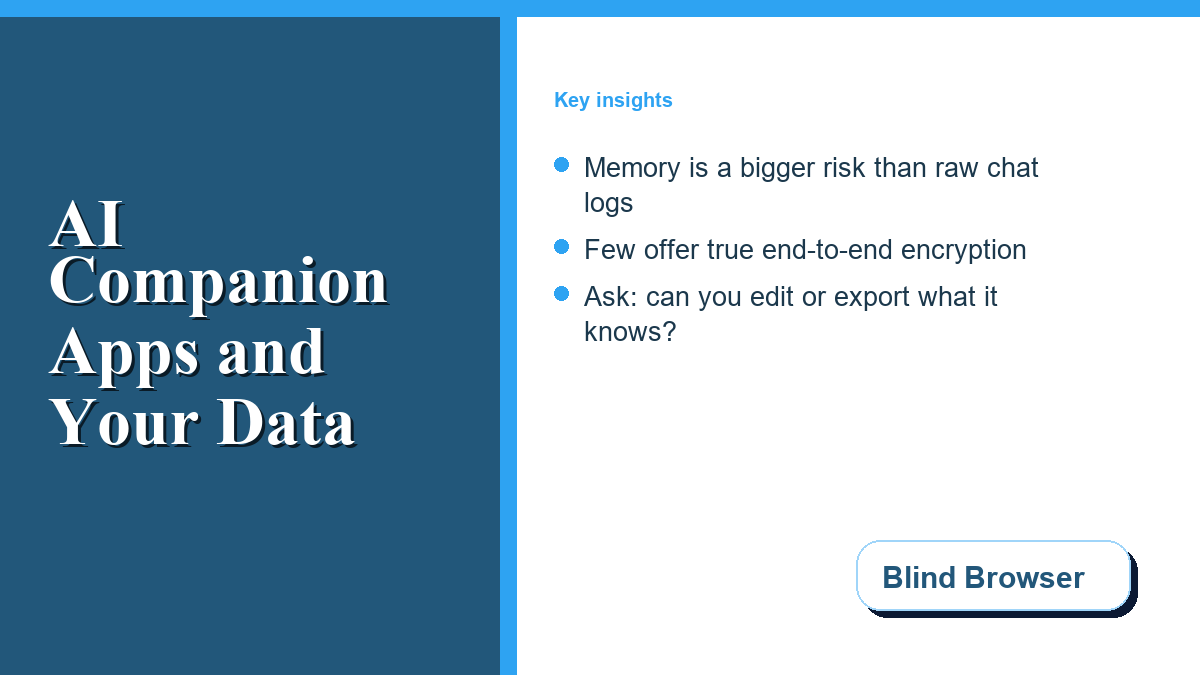
A memory store is a more concentrated privacy risk than a raw chat transcript, because it’s already distilled into structured facts about you — preferences, relationships, goals, recurring topics — rather than buried in conversational text a human would have to read carefully to extract. The human-like design of these apps is part of what makes this worth thinking about: the emotional closeness these products are built to create tends to lower a user’s guard and encourage sharing more personal information over time than a purely functional tool ever would.
What Actually Happens Behind the Scenes
Very few AI companion platforms offer true end-to-end encryption, and there’s a structural reason: the model itself needs to read the conversation to generate a response, which is fundamentally incompatible with content the platform can never see. Dedicated companion apps have consistently ranked among the weakest on privacy across independent reviews, in part because their business model depends on the emotional engagement — and the data that comes with it.
The Questions Worth Asking Before the First Real Conversation
- Can you see exactly what it remembers about you? A memory store you can’t inspect is a black box, regardless of how the privacy policy describes it.
- Can you edit or delete individual facts, not just wipe everything? The difference between “delete my account” and “delete this one thing it remembered” matters a lot in practice.
- Can you export what it has saved? A portable copy of your own data is a meaningfully stronger privacy position than trusting a platform’s internal deletion process.
- Do humans ever review conversations? Check specifically for this in the privacy policy rather than assuming an automated-only process.
What a Better Answer to This Actually Looks Like
The platforms handling this well let a user open their own memory store directly, review what’s in it, and remove specific items without nuking the whole relationship. Charigent’s approach to character chat with editable memory is built around exactly that distinction — memory you can search, review, edit, or delete at any time, with an export option for anyone who wants a copy of their own data outside the app.
The Honest Tradeoff
Choosing a memory-heavy AI companion is, by definition, choosing a richer experience over a smaller privacy footprint — that tradeoff doesn’t disappear no matter which platform is used. What varies enormously between platforms is how much visibility and control a user actually gets over that tradeoff once they’ve made it, and that’s the detail worth checking before the conversation history gets long enough to matter.