Adopting an AI chatbot for your business means giving a third party access to whatever it touches — customer conversations, internal documents, sometimes payment or health information. Most businesses evaluate a chatbot on what it can do. Fewer evaluate it on what happens to the data it sees, and that gap is where real exposure lives.
Read the Documentation Before the Demo
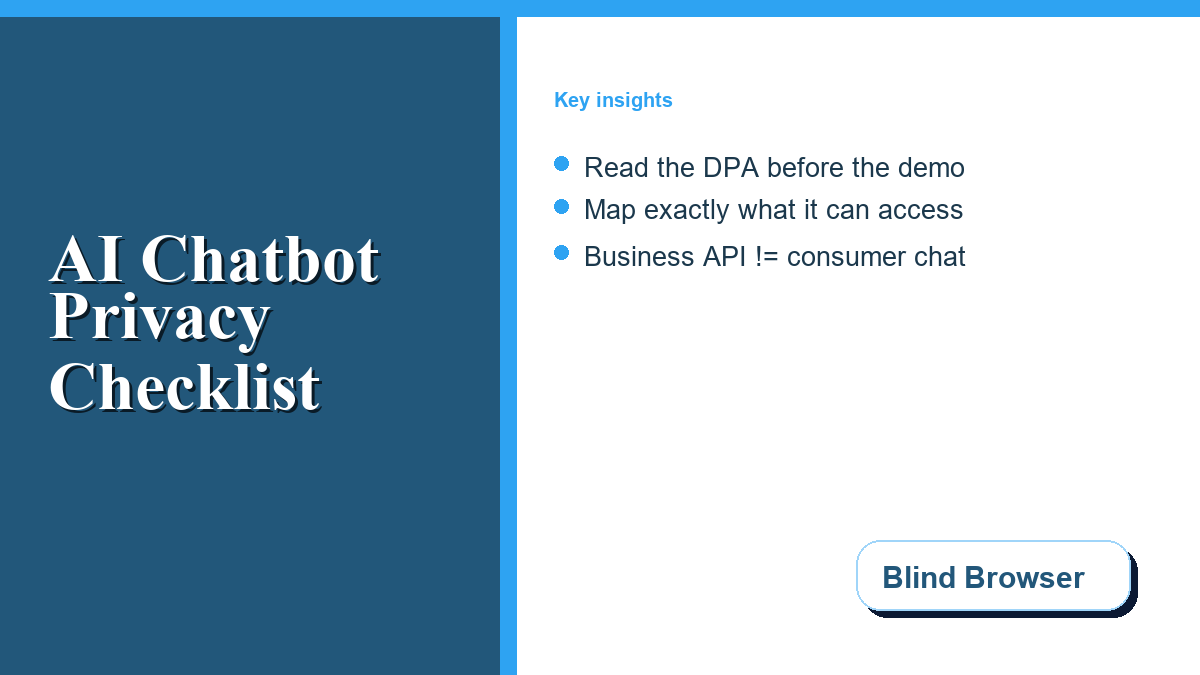
Before a single conversation happens, pull the vendor’s privacy policy, data processing agreement, and subprocessor list. A serious vendor answers direct questions about training, retention, encryption, and who inside their organization can access your data — without redirecting you to marketing copy. If a vendor cannot produce a clear data processing agreement on request, that is the answer to the question.
Know Exactly What the Bot Can Touch
Before deployment, map what the chatbot will actually have access to: customer PII, payment details, internal documents, regulated records, or just public FAQ content. Two principles should govern that scope — data minimization, meaning the bot only collects what it strictly needs, and purpose limitation, meaning that data is never repurposed for something you were not told about. If a vendor’s answer to “what does it access” is vague, assume the scope is broader than you want it to be.
Ask Where Processing Actually Happens
Retention period, processing location, and API-versus-consumer access all matter more than most sales conversations make them sound. Business API access typically means your data is not used to train the underlying model by default — a materially different arrangement than a consumer-facing chat interface, and one worth confirming explicitly rather than assuming.
Test Before You Trust
The most reliable evaluation method is not reading marketing pages, it is running a narrow pilot with real (or realistic, anonymized) data and watching what actually happens to it. Vendors that encourage a genuine pilot, rather than steering you straight to a signed contract, are showing more confidence in their own practices than any page of copy can.
Not every AI platform is built the same way on this front. For a look at how one connected AI workspace documents its security and data-handling approach, see Charigent’s security page as one example of what a vendor being specific about this looks like, rather than vague.
The Bottom Line
An AI chatbot is not just a feature decision, it is a data-handling decision, and it deserves the same diligence a business would apply to any other vendor with standing access to customer information. Five minutes reading a privacy policy before signup is cheaper than every alternative.