Acquiring an established company is a major milestone that requires detailed research and confidentiality. For anyone actively researching market entries through sources like Midwest Business Brokers, maintaining search privacy helps prevent competitors, employees, and intermediaries from reading too much into early-stage interest. In a tight-knit local market like Indiana, rumors of an ownership change can damage customer trust, trigger employee uncertainty, or invite competitive poaching. Conducting your initial search with disciplined privacy controls is not about secrecy; it is about protecting the stability of the enterprise you hope to buy.
When a buyer begins investigating listings, they often overlook the localized tracking that occurs. In a specific geographic market, even basic search patterns can reveal a buyer’s intentions. By implementing strict digital safety protocols, you can perform deep research on Indiana businesses without disclosing your identity before you are ready.
The Unique Challenges of the Indiana Market
Indiana has a robust and diverse business landscape, ranging from manufacturing hubs in northern Indiana to agricultural enterprises, logistics centers, and retail shops across the state. However, outside of Indianapolis, many communities operate as tight-knit business environments. If you are researching a specialty manufacturing firm in Elkhart County or a medical practice in Fort Wayne, the pool of candidates is small.
In these environments, typical search actions like looking up zoning files, checking local utility records, or calling local economic development offices can easily tip off the owner or competitors. Furthermore, local business brokers often communicate frequently. An inquiry made to one broker about a specific type of business in a particular county can quickly become common knowledge within regional brokerage networks.
To research effectively, learn to navigate Indiana’s databases and local market signals without creating unnecessary digital or physical exposure. This is why mastering privacy-focused browsing techniques is useful for any serious acquisition search.
Tip 1: Leverage State Public Portals Safely
The state of Indiana provides several online resources that are invaluable for business research. The primary portal is INBiz, managed by the Indiana Secretary of State. Through INBiz, you can access registration dates, registered agent names, principal office addresses, and the names of officers or managers.
However, accessing these records directly from your personal or office network can still create avoidable traces in browser history, network logs, or shared devices. The goal is not to avoid public records; it is to keep your early research compartmentalized until you are ready to enter a formal process.
To check these portals safely:
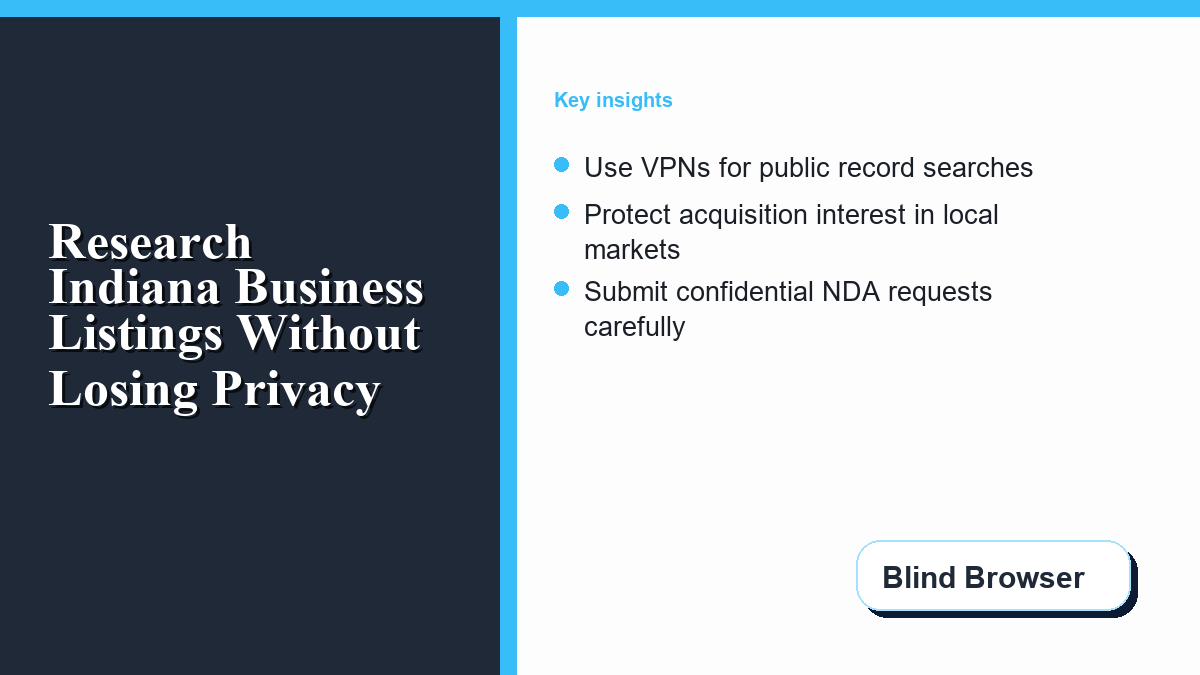
* Use a VPN: Ensure your VPN is set to an out-of-state server or a general server that does not match your target city. This masks your IP address and ensures that any traffic logged by state databases shows a generic location.
* Search Anonymously: Avoid logging into your personal INBiz or Access Indiana portal account when conducting initial research. Use the public, non-authenticated search features to gather entity names and filing numbers.
* Export Documents Carefully: When downloading PDF copies of business entity reports or articles of organization, do so on a secure drive. Some documents contain metadata that could reveal your download time and IP if shared later.
Tip 2: Shield Your Digital Traffic From Ad Trackers
When you visit public listing sites to view Indiana opportunities, ad networks immediately attempt to identify your industry and location. They do this by matching your IP address with database profiles that link your IP to your employer or residential address.
Once tagged, you may begin seeing targeted advertisements. For example, if you look at a logistics company for sale near Indianapolis, you might start seeing ads for commercial trucks, logistics software, or competing listings on local news sites. This tracking is not just annoying; it is a security risk. If a colleague or industry competitor walks by your screen and sees these highly specific ads, your confidential search is compromised.
You can prevent this by managing online presence through browser privacy tools. Use content blockers that stop ad scripts and tracking cookies from running. Clear your browser cache regularly, and use private window sessions that automatically discard session data when closed.
Tip 3: Conduct Confidential Due Diligence
As your research progresses, you will eventually need to ask specific questions about the target company. Vetting a listing requires asking the right due diligence questions when buying a business without giving away your identifying details.
When you contact a broker, they will require a signed NDA before releasing the Confidential Information Memorandum (CIM). To protect your privacy:
* Establish a Search Entity: Consider forming a separate, generic LLC (e.g., a holding company or consulting entity) to use as the signing party on NDAs. This keeps your personal name and current employer off the document.
* Review the NDA Terms: Ensure the NDA is mutual and contains strict confidentiality covenants that prevent the broker or seller from disclosing your existence as a buyer to any third parties.
* Use a Dedicated Communication Channel: Submit all inquiries using your dedicated search email and virtual phone number. Never use your personal or work contact details.
Ask generic questions first. Inquire about industry averages, customer concentration percentages, or lease terms rather than specific details that would require you to reveal why those details matter to your current operations.
Tip 4: Protect Your Physical Privacy
Physical research is just as important as digital research. If you plan to conduct a site visit or a drive-by of an Indiana business, protect your physical presence without misrepresenting who you are.
Never drive a company-branded vehicle to the location. If the business is a retail store or restaurant, visit during peak hours when you can blend in as a regular customer. Do not ask employees probing questions about the owner, the sales volume, or future plans. Simply observe the condition of the assets, the flow of customers, and the general management style.
If the business is a manufacturing facility or B2B operation where casual observation is not appropriate, do not invent a pretext to get inside. Wait until a formal, broker-guided tour is arranged under strict confidentiality agreements.
By taking these digital and physical precautions, you can evaluate Indiana business listings more carefully while reducing unnecessary exposure.