Exploring the market for acquisition opportunities requires careful planning and discretion. When reading materials from firms like Midwest Business Brokers and evaluating market options, it is easy to let excitement overshadow security. Before you click the contact button on a public listing site, assume that your browsing activity, inquiry timing, and form details may be tracked by the platform or its marketing tools. By taking systematic steps to verify a business listing privately, you protect your bargaining leverage and keep your acquisition plans confidential.
Acquiring a business is a high-stakes transaction where information is the primary currency. If a broker or seller can infer who you are, where you work, or how urgently you are searching before negotiations begin, you may give away leverage too early. By adopting a privacy-first mindset and using the right tools, you can vet listings carefully before deciding whether to make direct contact.
The Risks of Premature Contact
Many buyers assume that the initial inquiry form on a business listing site is harmless. In reality, submitting your name, personal email, and phone number can trigger data capture, automated follow-up, and CRM enrichment. Depending on the platform and the tools connected to it, a brokerage may be able to connect your inquiry with public professional profiles, company information, or prior website visits.
Furthermore, visiting these platforms without protection allows tracking pixels to drop cookies on your device. These cookies follow you across the web, triggering retargeting ads for business sales on your social media feeds. If you share a home or office computer, these ads can easily alert family members or coworkers to your confidential search.
To maintain control over your search, separate your personal identity from the early research phase where practical. This starts with ensuring data privacy while browsing by implementing basic safety measures before you begin visiting online marketplaces.
Step 1: Perform Anonymous Off-Platform Verification
Before you ever make contact, you can verify a significant portion of a listing’s claims through public, independent sources. Most business listings are intentionally vague to protect the seller’s confidentiality, but they usually contain geographic and operational clues.
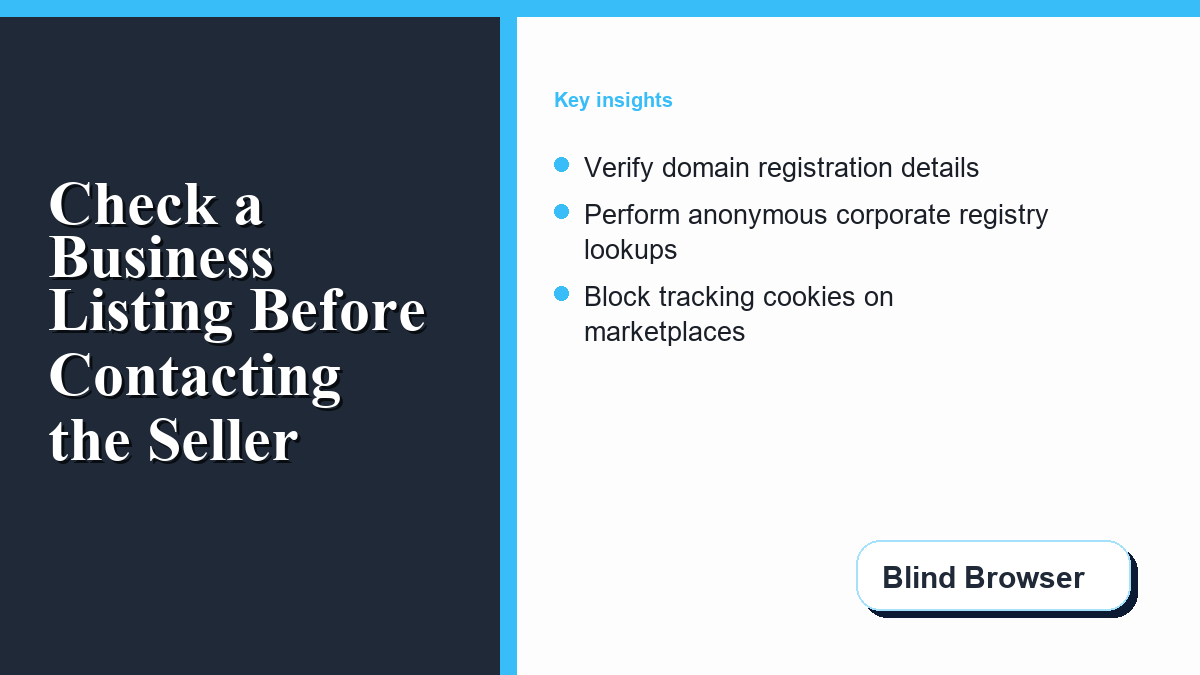
First, identify the likely location of the business. Listings often mention the county, major nearby highways, or specific demographic details. Use public mapping services to identify businesses in that sector matching the description. Once you have a candidate, check their public website. You can look up the website’s registration date using WHOIS lookup tools. A business claiming ten years of steady growth should have a domain registration history that reflects that timeline.
Second, search state corporate registry databases. Every state maintains a public portal for registered business entities. You can search these databases for active corporations, LLC filings, registered agents, and annual report filings. Vetting these corporate records helps you verify that the entity is in good standing and confirms how long it has been operating. When performing these lookups, avoid using a work network if the search could reveal sensitive acquisition intent to your employer’s IT systems or shared browser history.
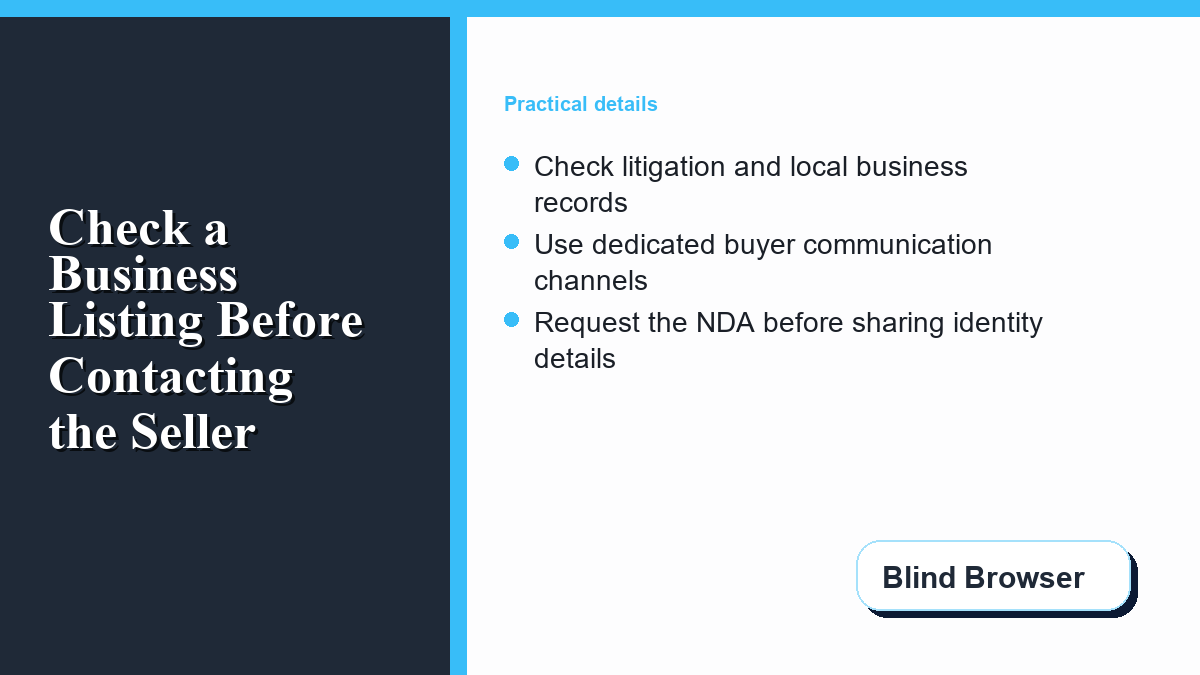
Third, search local court dockets and news archives. Look for any active litigation, zoning disputes, tax liens, or labor issues associated with the business or its owners. Discovering these red flags early allows you to walk away before spending time or money on a broker conversation.
Step 2: Utilize Safe Browsing Tools
To prevent listing platforms from building a profile on you, you need to obscure your digital connection.
- Virtual Private Networks: Always use a virtual private network (VPN) when researching businesses. A VPN encrypts your traffic and masks your IP address, making it appear as though you are browsing from a different city or region. This prevents platforms from linking your search history to your physical office or home location.
- Dedicated Browser Profiles: Set up a clean, separate browser profile dedicated solely to your business search. This profile should have all history, cookies, and autofill data cleared. Avoid logging into your personal Google, Microsoft, or social media accounts while using this profile.
- Block Trackers and Pixels: Install browser extensions that block third-party trackers, analytics scripts, and advertising pixels. You can configure privacy settings for safe browsing to ensure that your activity on one listing platform is not shared with advertising networks or other brokerages.
Step 3: Analyze the Listing Details for Authenticity
Once your browsing environment is secure, turn your analytical attention to the listing itself. Not all business listings represent legitimate, viable opportunities.
Look closely at the financial summaries provided. Legitimate listings will present clear, separate figures for gross revenue, seller’s discretionary earnings (SDE), and inventory value. Be skeptical of listings that bundle these numbers or show round, clean numbers that suggest estimation rather than actual accounting.
Pay attention to the language used. Boilerplate descriptions that rely heavily on buzzwords and offer little substance are often placeholders for distressed businesses or brokers fishing for buyer leads. If a listing emphasizes urgency, such as a health crisis or partnership dispute, verify this claim if possible. While these situations do occur, they are also common sales tactics designed to rush buyers past their due diligence.
Remember, do not take any financial or valuation claims in a listing at face value. They are marketing materials, not audited financial statements.
Step 4: Establish Secure Communication Channels
When you are finally ready to reach out to a broker or seller, do so through a dedicated communication buffer.
Create a professional, generic email address on a secure domain specifically for this search. Do not use your personal name or current employer in the email handle. Similarly, set up a temporary virtual phone number that forwards to your mobile device. This keeps your personal phone number out of broker databases, where it could be shared or sold.
When navigating a business for sale marketplace, keep your initial inquiry brief and focused on requesting the non-disclosure agreement (NDA). Do not volunteer details about your net worth, financing approvals, or specific background in your first message. Simply state that you are a qualified buyer interested in receiving the confidential information memorandum (CIM) for the listing and request their standard NDA.
By keeping your research anonymous and your initial contact disciplined, you protect your privacy, avoid aggressive broker outreach, and ensure you enter negotiations from a position of strength.